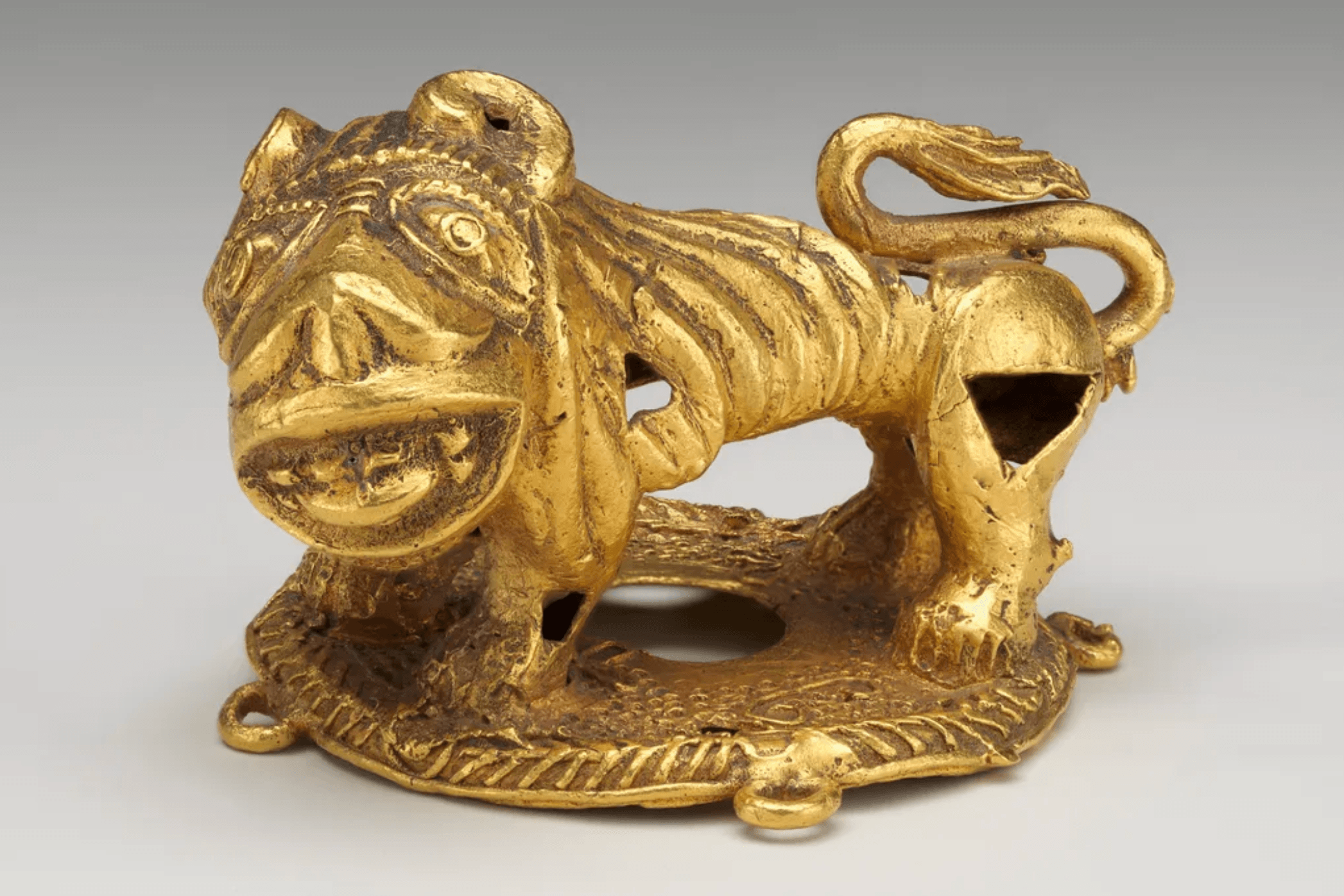
Image: A gold lion ornament created by an Akan artist Metropolitan Museum of Art
Europeans spread rumors about degraded gold from their Akan trade partners. A new analysis of artifacts from the “Whydah Gally” shipwreck tells a different story
By Ryley Graham
When the Whydah Gally shipwreck was discovered in 1984 off the coast of Cape Cod, scientists and historians studied its artifacts to update historical narratives about 18th-century trans-Atlantic trade. New research about the ship’s bounty, published last month in the journal Heritage Science, corrects what its authors consider an old myth: the belief that West African traders “passed off adulterated materials of lesser value as high-karat gold.”
“The accusations of systematic fraud that Europeans wielded for generations to justify their distrust of African traders now confront scientific evidence,” writes Guillermo Carvajal for La Brújula Verde.
In early 1717, near the Bahamas, the infamous pirate Samuel Bellamy captured the Whydah Gally, an English slave ship traveling from Jamaica to London with a cargo of spices, dyes, rum and precious metals. Soon after, Bellamy and his crew were caught in a storm off the Massachusetts coast. The ship sank, killing most of the crew and scattering the bounty on the ocean floor.
More than 200,000 artifacts have been recovered, providing an unparalleled window into the era’s trade in commodities—and human beings.
Read the full article on Smithsonian Magazine:
https://www.smithsonianmag.com/smart-news/pirate-shipwreck-off-the-coast-of-cape-cod-sets-the-historical-record-straight-on-west-african-gold-180988572/