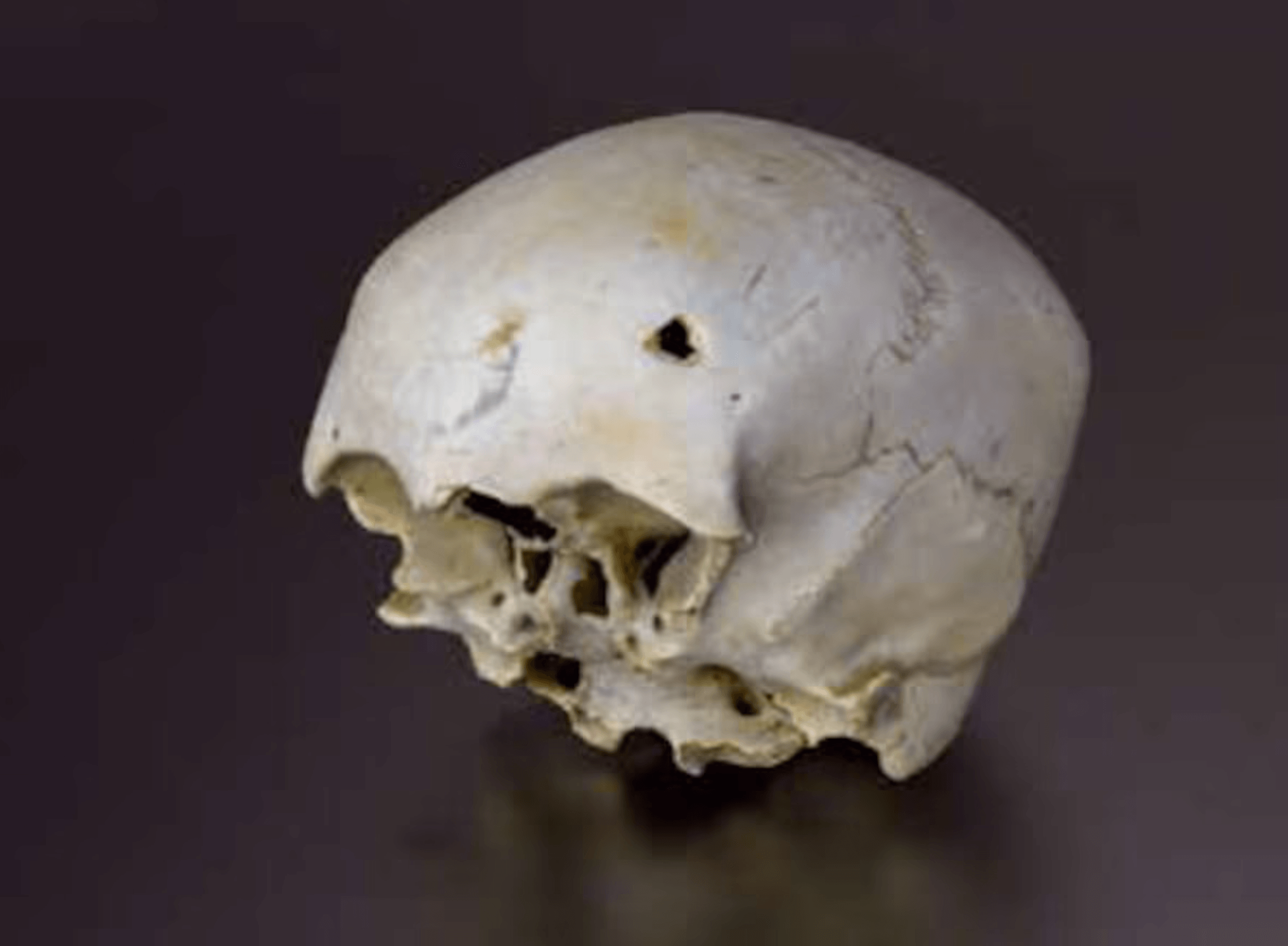
Image: Skull of a woman with a frontal fracture found in the Bay of Cádiz. MILAGROS ALZAGA GARCÍA
The ship, covered by eight meters of sediment, is preserved in ‘excellent condition,’ as is its cargo
By Vicente G. Olaya
Sir Francis Drake was a pirate — according to the Spanish — an honorable mariner — according to the English — commanded by Elizabeth I of England to destroy the cities, fortresses, fields, farms, or subjects of Philip II wherever they might be. Drake launched his attacks across both hemispheres without warning. He could strike against Santo Domingo, the Canary Islands, or Patagonia. There were no limits. One of the ports he successfully attacked was Cádiz in 1587.
In the Bay of Cádiz, Philip II was building part of the armada with which he planned to attack England. Therefore, Elizabeth I ordered Drake to destroy those threatening armed galleons endangering her kingdom. Thus, the English mariner, in a daring maneuver, entered the Andalusian port and sank between 30 and 35 Spanish, Portuguese, or allied ships.
Among them was the Italian vessel San Giorgio e Sant’Elmo Buonaventura, whose holds were filled with a wide variety of goods. Dredging in the Bay of Cádiz has now allowed for the recovery of the ship’s wreck. This is detailed in the multidisciplinary study “Experimental Sciences in Underwater Archaeology: Delta II Wreck (San Giorgio and Sant’Elmo Buonaventura).” Using techniques from genomics, dendroarchaeology, paleobiology, physicochemistry, archaeology, and archival science, the experts have reconstructed the ship’s sinking. And much more.
Just eight meters below the sediment lay the almost intact ship. It was sunk on April 29, 1587. “The organic remains found were in an excellent state of preservation due to the great thickness of the mud layer that the buried wreck had retained, providing an anaerobic environment that prevented the deterioration of a fragile and therefore easily decomposable material; which, moreover, has great heritage and scientific value.”
Read the full article on EL PAÍS:
https://english.elpais.com/international/2026-04-22/almost-intact-italian-ship-sunk-by-francis-drake-in-the-16th-century-discovered-in-the-bay-of-cadiz.html