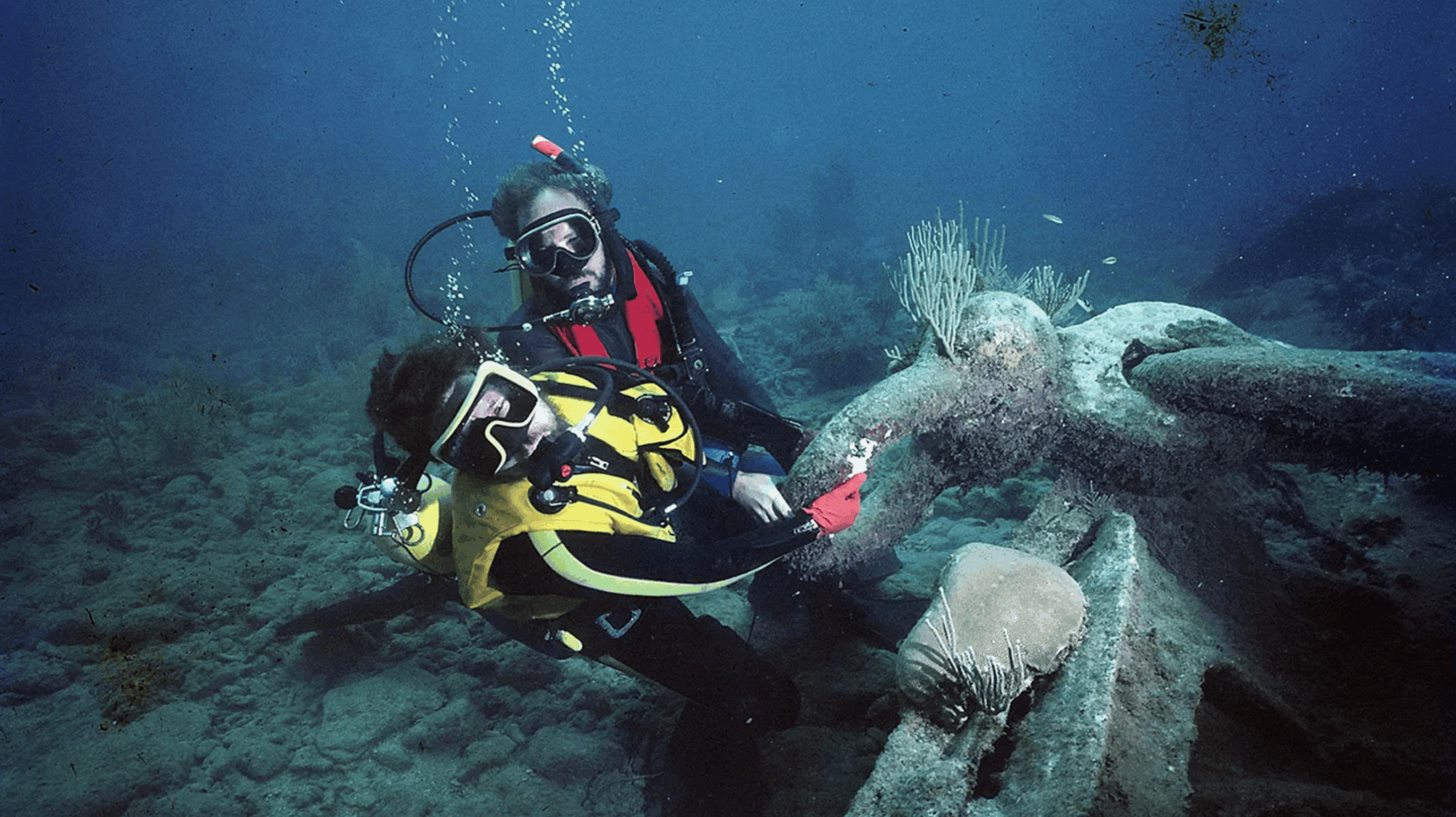
Image: Roger Dooley (in yellow) and a friend explore a Cuban shipwreck in the 1980s in a photo taken by Al Giddings. Courtesy of Al Giddings
After a 30-year search, Cuban American archaeologist and filmmaker Roger Dooley discovered the Holy Grail of Shipwrecks, with a treasure worth billions.
By Julian Sancton
In the mid-1980s, around the time The Goonies delighted moviegoers with its story of pirate treasure, the 39-year-old Cuban American archaeologist Roger Dooley was deep in a Byzantine Spanish archive, hunting for a treasure ship of his own. As an archaeologist, he didn’t particularly care about treasure. But his boss did: Dooley was working for a state-run Cuban company called Carisub, formed by Fidel Castro to extract riches from the sea, including from the many Spanish wrecks thought to lie around the island nation.
While under the archive’s vaulted ceiling, he chanced on long-hidden documents that contained clues to perhaps the greatest sunken treasure of all time: the legendary galleon San José, which sank in battle with a British squadron off Colombia in 1708, along with 600 men and a cargo of gold and silver estimated to be worth billions of dollars. It has been called the Holy Grail of Shipwrecks.
“That’s the day I fell in love,” Dooley told me in one of our many interviews for my new book on the galleon, Neptune’s Fortune (Jan. 27). Being outside Cuba’s waters, the San José would be of no use to Castro. But the notion formed in Dooley’s mind that he would one day find it.
Read the full article on The Hollywood Reporter:
https://www.hollywoodreporter.com/movies/movie-features/filmmaker-roger-dooley-holy-grail-of-shipwrecks-treasure-1236473545/