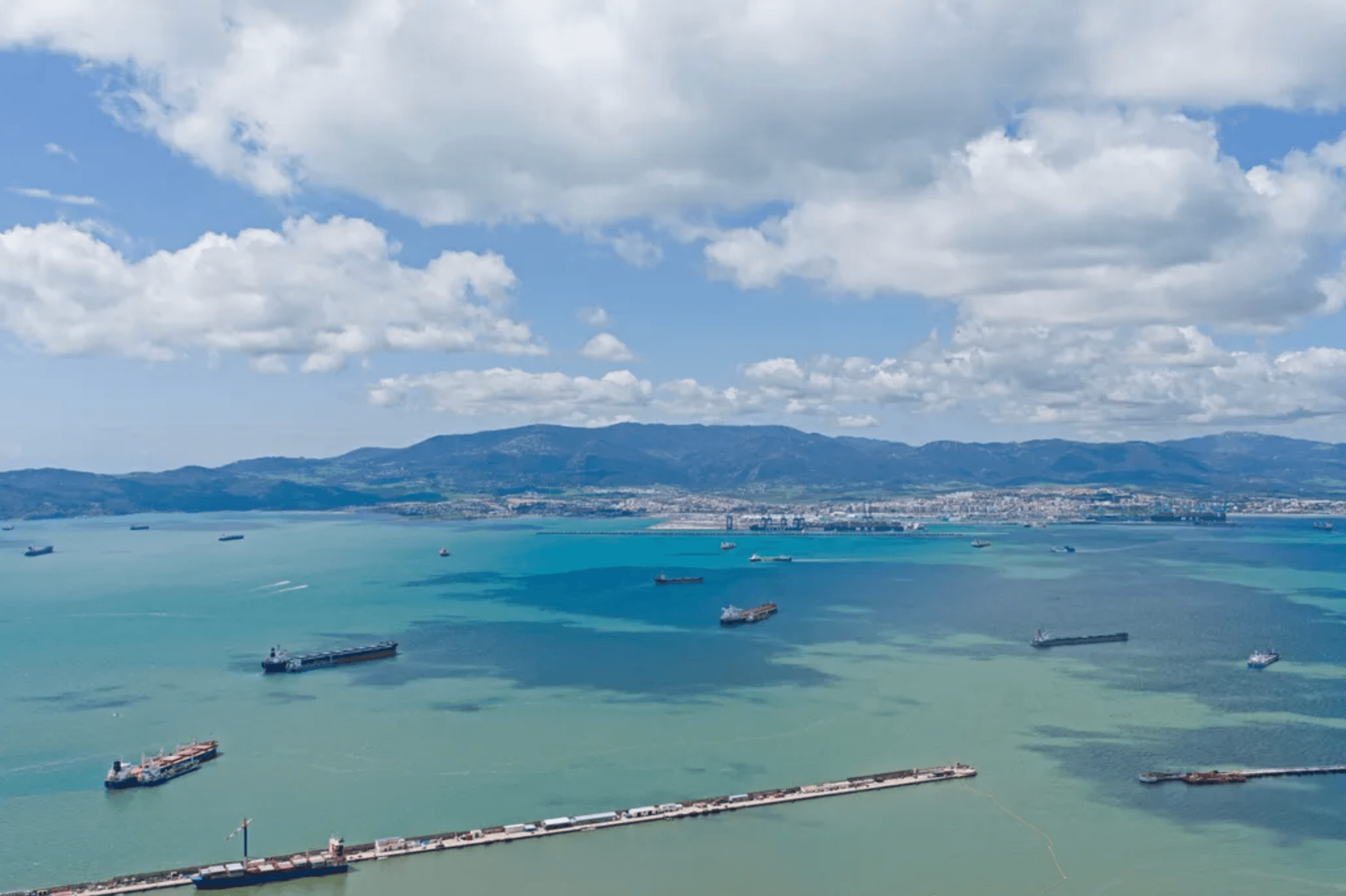
Image: The Strait of Gibraltar Ymblanter via Wikimedia Commons under CC BY-SA 4.0
The “harbor” of the Strait of Gibraltar is the final resting place for shipwrecks from ancient Rome, the medieval era and World War II, according to a new archaeological survey
By Michele Debczak
The Strait of Gibraltar hosted numerous naval conflicts over millennia, spanning from ancient Rome to World War II. New research gives archaeologists their clearest picture yet of the passageway’s dangerous history. As Darren Orf put it for Popular Mechanics, a “shipwreck graveyard” of more than 100 vessels was discovered in the Bay of Gibraltar (also known as the Bay of Algeciras), at the eastern end of the strait.
Separating North Africa from Europe and connecting the Atlantic Ocean to the Mediterranean Sea, the Strait of Gibraltar has served as a significant maritime route for generations. The bay itself was the site of several major battles, including the Battle of Gibraltar, in 1607, and the First Battle of Algeciras, in 1801.
As the “harbor of the strait,” the Bay of Algeciras is a natural place to look for evidence of the passageway’s rich nautical history. For an unpublished study called Project Herakles, archaeologists associated with universities in Spain, Argentina and Portugal narrowed their focus to a 29-square-mile section of the strait located between the southern port of Algeciras and the Rock of Gibraltar.
Felipe Cerezo Andreo, an archaeologist at the University of Cádiz who led the study, told CNN’s Amarachi Orie that “all vessels that want to go from [the] Mediterranean to [the] Atlantic have to pass through the Strait of Gibraltar, and probably most of them have to anchor and wait for better weather conditions in the Bay of Algeciras.”
While conducting a survey of the bay from 2020 to 2023, researchers identified 151 archaeological sites, including the remains of more than 100 doomed ships. The artifacts cover nearly 2,500 years, stretching as far back as the Punic era in the fifth century B.C.E.
Read the full article on Smithsonian Magazine:
https://www.smithsonianmag.com/smart-news/in-a-graveyard-of-shipwrecks-between-europe-and-africa-archaeologists-discovered-vessels-doomed-over-thousands-of-years-180988605/