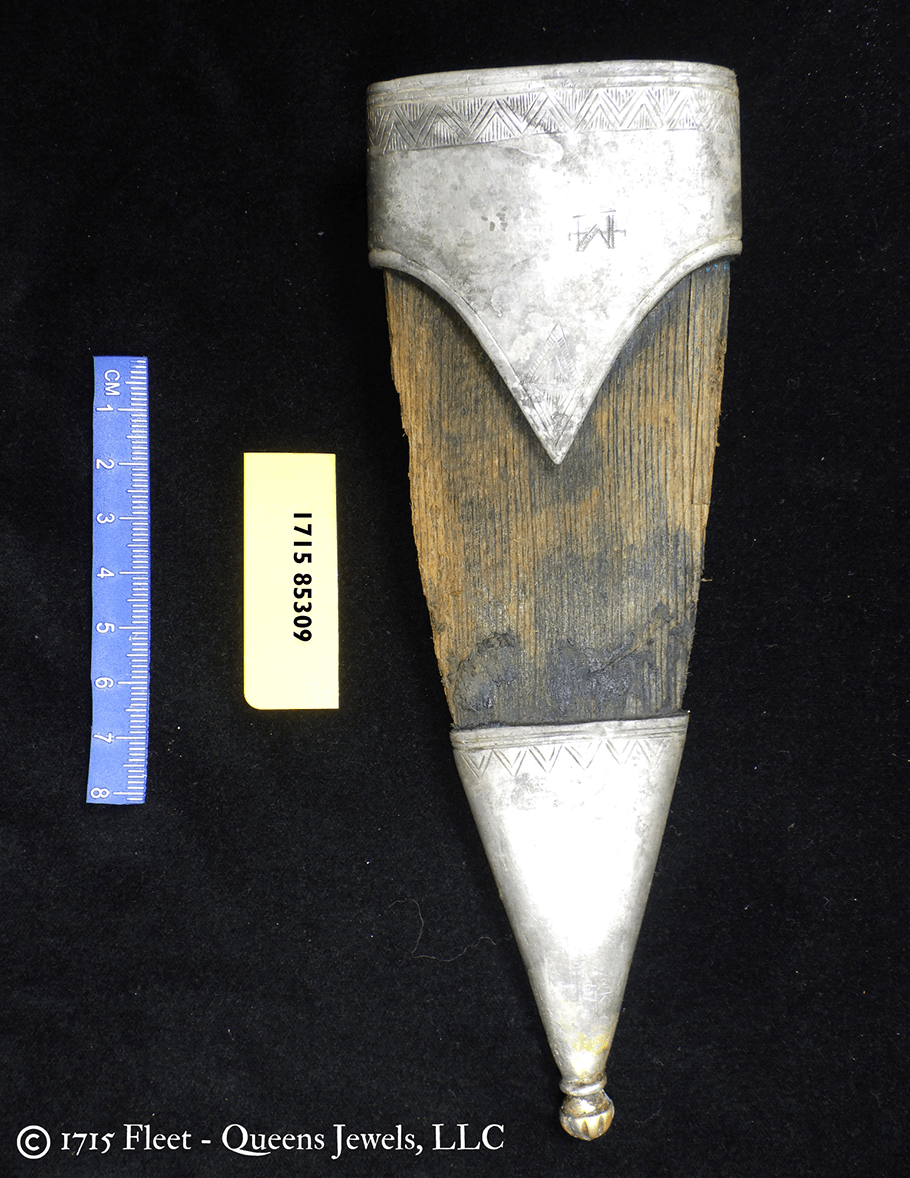
Archaeologist and Fleet Society Advisory Board member, Jim Sinclair, offered the following comments on our most recent Treasure of the Month:
Very cool artifact indeed.
One of the phenomena that I have noticed through the years is the fact that quite often, wood will be preserved when in close proximity to iron that is deteriorating. I called it generally iron bulking.
When wood is submerged for extended periods of time in an aerobic environment, such as what occurs on the 1715 Fleet wrecks the “lignan” in the wood (read that cellular materials are replaced by salt water). Anyone who has ever brought an ancient piece of wood off the bottom, thinking this will look great, was most likely very disappointed in the appearance of the object after the water contained in the wood evaporates. I personally have seen what appeared to be robust wood objects turn into what was basically a pile of sawdust in very little time.
There are some notable exceptions, “lignum vitae” used for various things aboard some vessels (for many years, submarines used this wood for ball bearings), which can hold up pretty well. This has to do with the oils present in that species of wood; it made them basically self-oiling.
I have also seen, like many who have worked on the 1715 Fleet, iron nails, pins, and other fasteners that still have remnants of wood attached, usually near the head of the pin or nail. To my way of thinking, this is because the wood has been infiltrated (to a degree) by the iron deterioration products of the iron object to which it was attached.
I would think that the iron blade of the knife of this artifact, as it deteriorated, was very crucial to the preservation of the sheath. The leather, depending on how it was tanned, was likely helpful in keeping wood-boring organisms from the wood of the sheath also. This is seen even on deep water wrecks that hold leather passengers’ luggage. RMS Titanic, 1912, and SS Central America, 1857, come to mind.
In any case, a fascinating and unique find. Three cheers to the crew of the vessel and the diver for rescuing this piece of history.
A great job was done by Mike Perna on the conservation of the piece.
Jim Sinclair, MA
Maritime Historic Archaeologist
SeaRex Inc.