Meteorological tsunamis likely sank the 13th-century trading vessels, whose cargo included objects from both Christian kingdoms and Moorish communities on the Iberian Peninsula
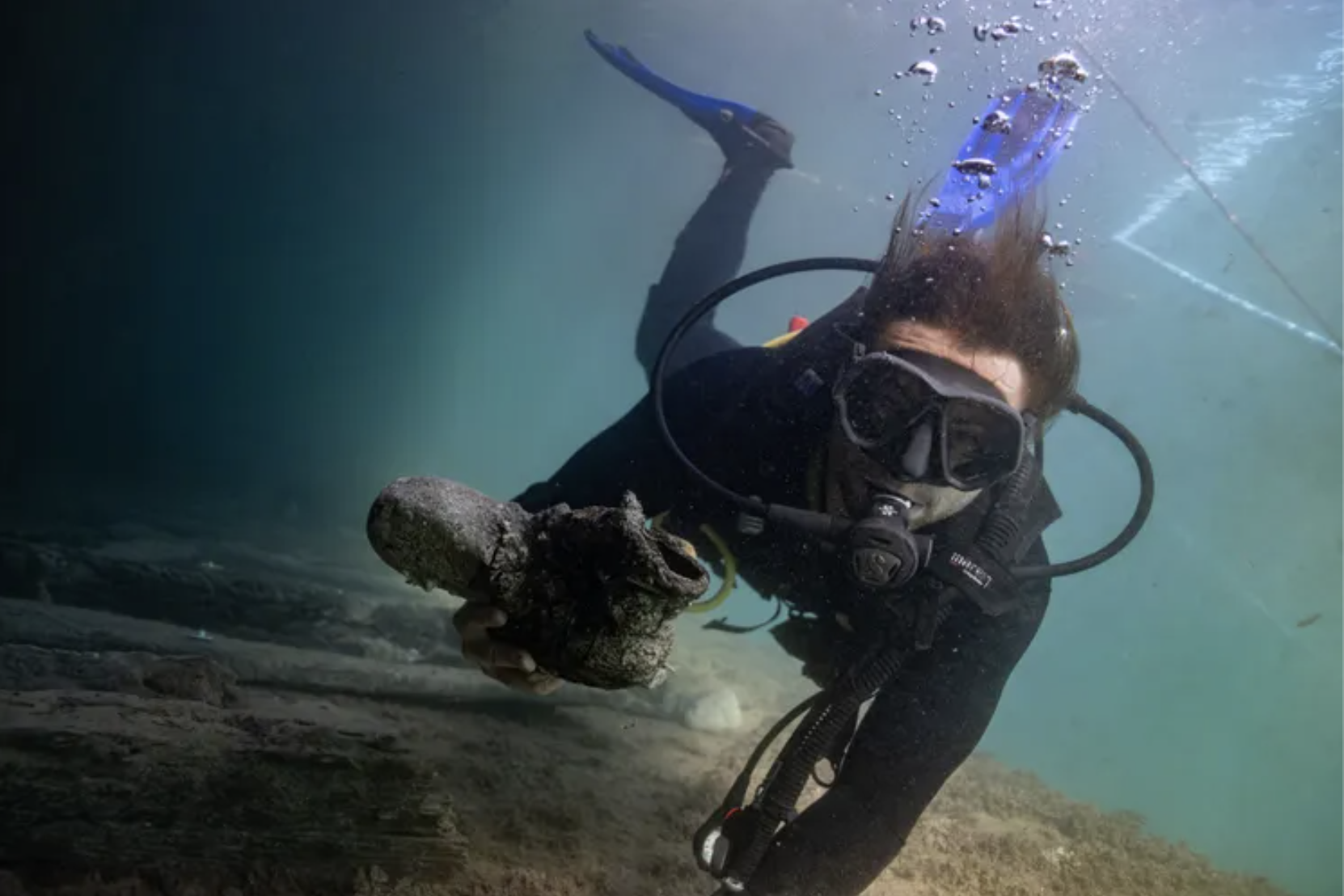
Image: Archaeologist Gino Caspari holds an iron artifact recovered from one of the Menorca shipwrecks. Trevor J. Wallace
By Katie Hitchcock-Smith
The murky, near-zero visibility for the October 2025 dive was “like chocolate,” said Xavier Aguelo Mas, a Catalan archaeologist with the Menorca Shipwreck Project. Donning a fraying wetsuit, he strode down the wooden boat landing toward the Spanish island’s “Cove of Mysteries,” encouraging the researchers and expedition members behind him to follow: “We dive anyway!”
Amid the scattered wreckage rests a rare anomaly: three 13th-century vessels whose overlapping resting spots suggest that they sank simultaneously. Aguelo Mas first started surveying the site in 2009, but excavations funded by the Menorca Shipwreck Project—a collaboration between the New York City-based Explorers Club and local archaeologists and cultural heritage experts—only began in 2023.
Originally believed to be 18th-century shipwrecks, the vessels are far older and rarer than initially thought, a wood-dating analysis conducted in 2025 revealed. Expedition leader Trevor J. Wallace, who is also the project’s founder, has dubbed the ships Busquets I, II and III, after the cove where they were found. Their original names and many of the island’s other medieval records were likely lost when Alfonso III of Aragon conquered Menorca in 1287.
Read the full article on Smithsonian Magazine:
https://www.smithsonianmag.com/history/take-an-exclusive-look-at-three-newly-discovered-medieval-shipwrecks-in-menorcas-cove-of-mysteries-180989092/