Introduction
In the summer of 2025, history was being made along the east coast of Florida just north of Vero Beach. There, a group of dedicated salvagers were recovering the largest single group of Spanish silver reales since the 1990’s. All in all, a total of 1,048 coins were reclaimed from the Atlantic where they had resided for 310 years. This remarkable story started on June 20 when Levin Shavers and his crew of one (First Mate, Luke Fullers) set out on their boat, the Just Right, for another attempt at finding treasure. Levin was a subcontractor for 1715 Fleet-Queens Jewels, LLC. (hereafter referred to as Queens Jewels) Queens Jewels is the official U.S.Court Custodian and exclusive salvaging company for the historic 1715 Fleet wreck sites. It was their third day out. As luck would have it, Levin was on his way to finding the cache of a lifetime.
It started with eight coins that day, then more and more. Each day the number grew, leading up to the 8th of July when 291 coins (eight and four silver reales) were located and recovered. This continued until mid-July; the number of coins ran out. But most remarkably, all of this occurred by chance…a bow anchor that was dragging along and ended up dropping at a location that was not their original destination. They ended up in seven feet of water, a stone’s throw from the beach.
After the recovery, Levin was involved in the conservation of the coins along with Captain Mike Perna (Lead Conservator for 1715 Fleet-Queens Jewels, LLC.), Matt Paleo, and several other individuals. During the conservation, Levin was intrigued by an eight reales coin that just didn’t look or feel right. Several others were found, and after consulting with some of his colleagues, it became apparent that he had uncovered what he believed to be possible contemporary counterfeits, or stated another way, counterfeits that were made at or near the time that the1715 Fleet was lost.
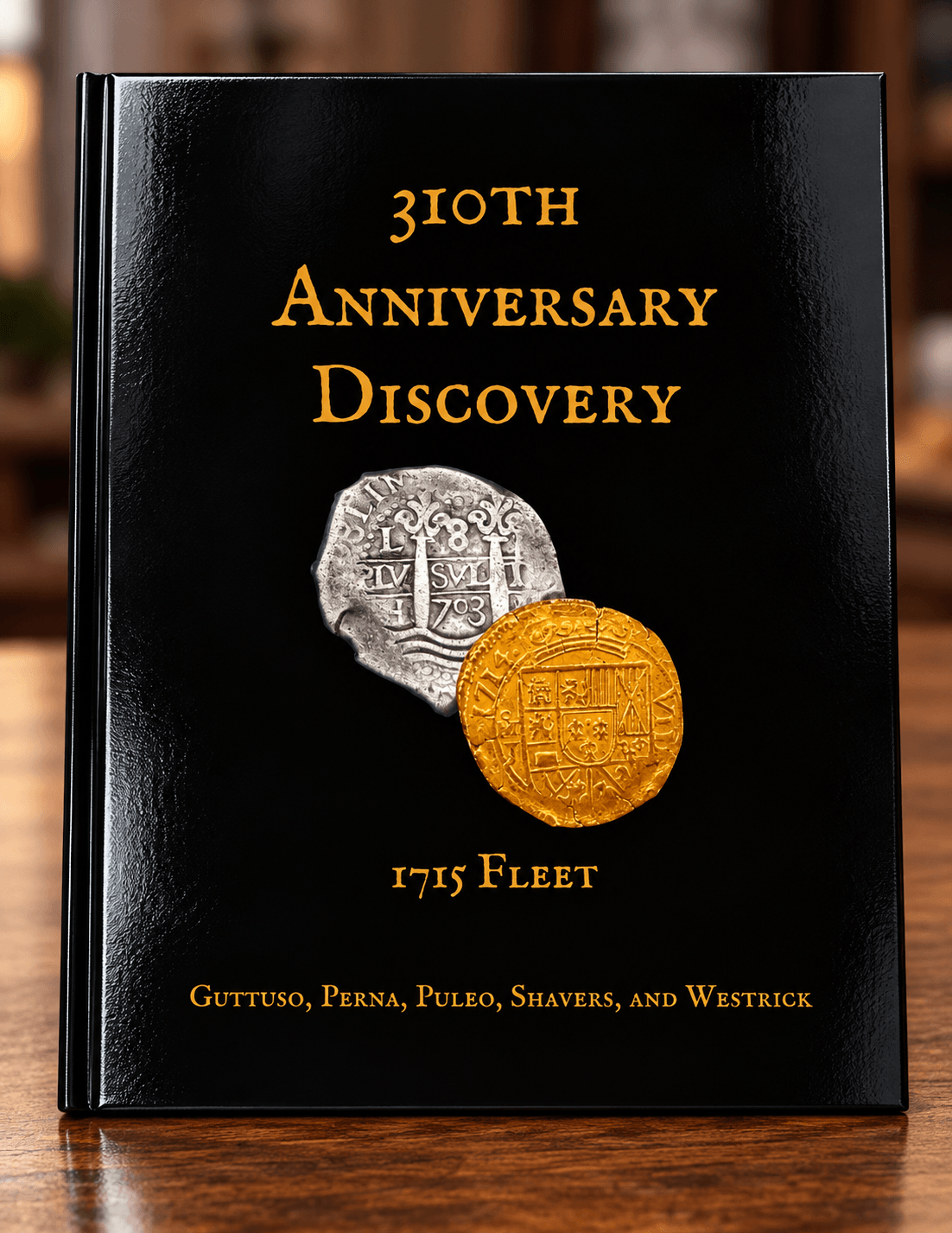
After extensive research, Levin wrote an article about these possible contemporary counterfeits, which you will find below. It is an excerpt from the upcoming book written by Sal Gattuso, Mike Perna, Matt Paleo Levin Shavers, and Rob Westrick. This book, entitled “310th Anniversary Discovery”, is a compilation of all the coins recovered from this historic find.
The Fleet Society is truly honored to be the first to introduce this new book to the public and provide Levin’s article on possible contemporary counterfeits. This book will be available for sale in December 2026.
Possible Contemporary Forgeries
By Captain Levin Shavers
Let’s take a closer look at four possible contemporary counterfeit coins out of the 1048 silver coins we salvaged during the summer operations of 2025. On our 3rd day out, and 12 excavations in, we came across a single coin that would eventually lead us to the rest of our discovery. 19 days later, with 700 excavations behind us, we managed to recover over 1000 silver coins. Although remarkable for today, this was nothing compared to what Kip WagnerKip Wagner (1906 – 1972) was instrumental in the formation of the team that later became the Real Eight Company and one of the greatest salvage groups that ever explored the 1715 Fleet wrecks. He was... More and his team, the “Reale 8,” recovered in the 1960s. At that time, they were salvaging literal tons of silver; 5,000 silver coins were just a number. They achieved that for a few seasons straight. During these huge recoveries, I’m sure some well-peeled eyes saw many extremely interesting specimens among the thousands of silver coins over the years. Yet the topic of contemporary forgeries in 1715 Fleet coins is almost nonexistent, with very little information on the subject in general. These four coins are unique and deserve a closer look that will help us to better understand the discovery.
After speaking with Ben Costello on the subject, he made a good point. Most of the large recoveries of coins were chests. The Royal Fifth or Quinto consisted largely of newly minted coins in boxes made up of 3 bags, each with approximately 1000 coins. This totaled about 3000 coins per chest. These were usually the same denomination – 8 reales and of the same mint. This is consistent with other historic shipwreck recoveries like the Atocha and Santa Margarita (1622). State documentary research indicated that a chest discovered on the 1715 Fleet in the early days of modern salvage contained 3,000 troy ounces of silver, divided among three bags of 1,000 ounces each. The coins were four- and eight-real denominations, with the authors estimating approximately 3,750 coins in the concreted mass (Burgess and Clausen 1982). Ben also mentioned there would be no way a mint would let a forgery into a bag of coins. Our find was a mixed bag of eight reales and four reales of almost even quantities. It was evident they were in a bag because of canvas markings in the encrustation on the coins and clumps near the main deposit. Most of the coins were minted in Mexico, with a small amount (9) minted in Lima and (12) in Potosi. In comparison to past recoveries, the range of dates and different mints suggest that this was an accumulation of coins over a period of time in the New World. Examples of dated coins range from 1702 to 1714, with other earlier examples from assayer L without visible dates. These clues separate this collection from that of a freshly minted batch of coins headed back to Spain. Instead of a concise group of coins, we have a swath of colonial pieces. Were they a consignment, transfer of wealth, or contraband? Whatever the case, a curious find for sure.
While I believe many of the coins of the discovery deserve a closer look, the four coins we are going over offer us a distinct opportunity to analyze examples of a common practice with high consequences that still persist in society today. This is forgery and counterfeiting of what would become the first American dollars.
Essentially, the golden age for counterfeiting the irregular-shaped cob and its massive production practically allied with criminal intent. There are many ways to deface cobs. But these examples represent what appear to be manufactured forgeries. With irregular figures, off-center markings, and illegible characters. Each coin’s monograms are somewhat comparable to contemporary pieces but have significant differences.
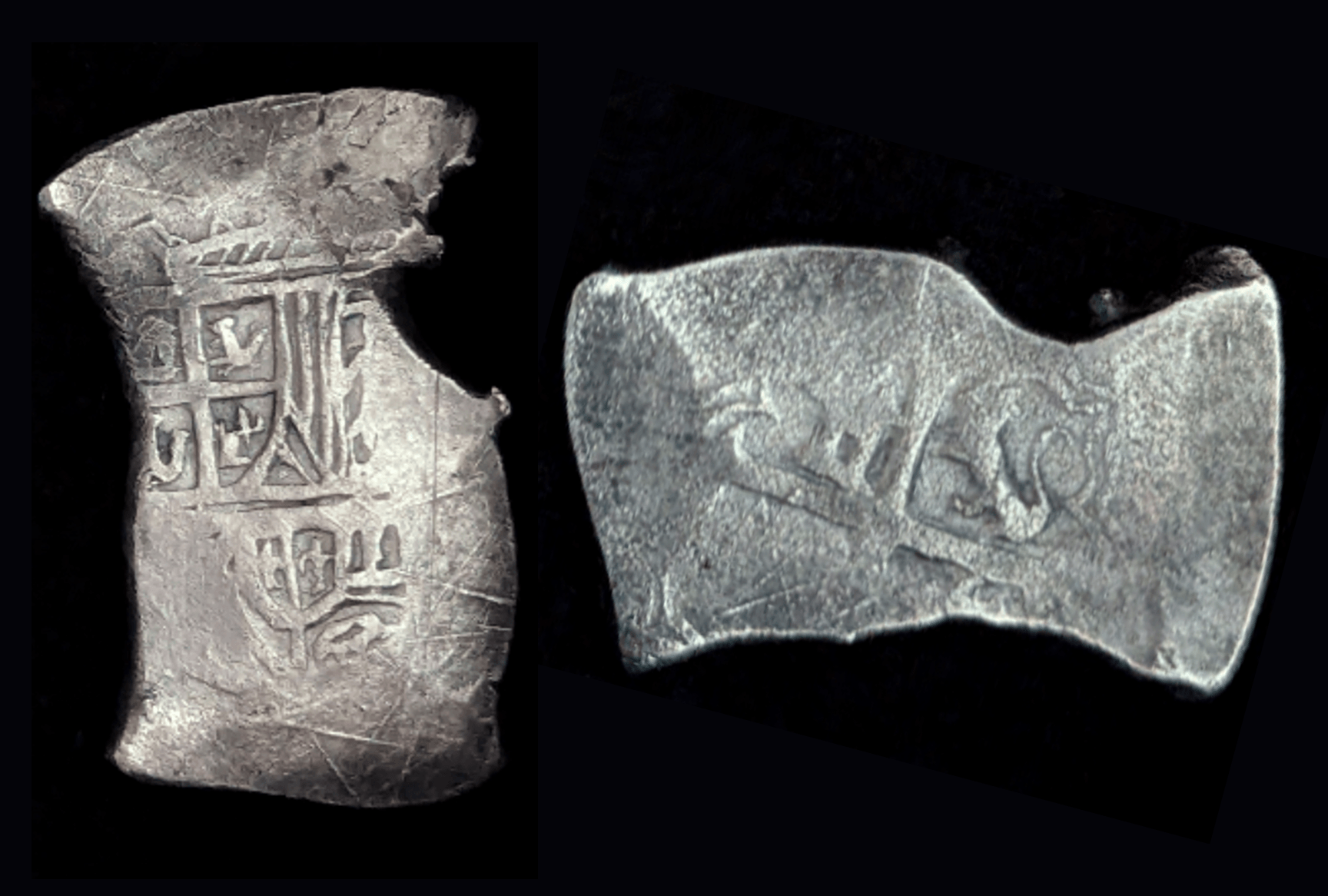
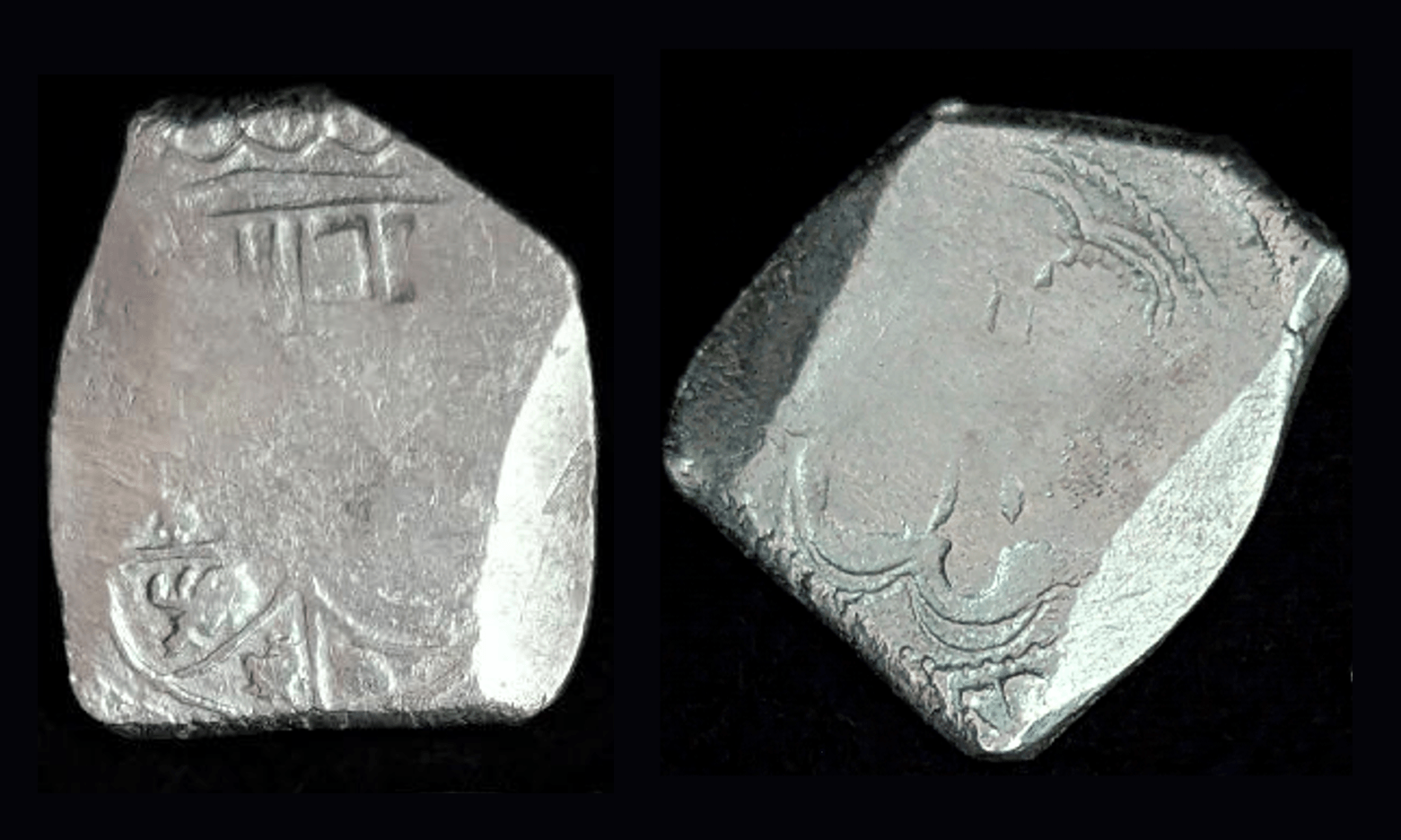
Coin 9041-16 was the first example that I recognized as having unusual markings, abnormal to the typical die strike markings. In fact, it was unmistakably different, as I had handled hundreds previously, carefully examining each one. Different mints, double or poor strikes, perhaps well-used die-distorting markings, offered the occasional anomaly, but none exhibited markings like coin 9041-16. The shield or obverse side of the coin has the qualities of an earlier Habsburg shield (pre-1700). Closer to the early 1600s Mexico shield type designs. So, this is what we will compare it to. In the quadrant on the upper left side of the shield, what should be a lion appears more like the Roman numeral “V” or the letter “V” with tiny features added. A shape and style I have not seen in any other die strike. Below is an unrecognizable shape that should be a castle. In the center, there is an extra line through Granada. Under this, representing Flanders and Tirol, the symbols look identical in shape and fairly crude. Below that, on the bottom right side of the shield, the lion symbolizing Brabant looks to be gazing in the wrong direction and is a different shape entirely. Above the shield, the crown is off-center and out of scale. The left side of the crown should end between the top left quadrant and not directly in line with the center line of the quadrant. There are unusual troughs between the peaks of the crown and other details that further separate it from that of the typical Habsburg crown. On the reverse, the cross has the qualities of an earlier 1600-1630 type. The one visible lion is more upright and very elongated in shape. The one visible castle has an abnormally large entrance or opening and lacks the upper architectural details. The tressure surrounding the cross is very sharp and prominent. The points of it reach a bit further into the spaces designated for the lion & castle than authentic examples. Over the surface of the coin are numerous scratches. Looking closely, they are embossed markings. In my opinion, this indicates casting. Whoever made this mold to cast the coin mistakenly put these scratches into the mold. I believe this was done in an attempt to create a more circulated appearance on the surface of the coin. They should have embossed the marking on the mold to create the desired effect on the actual cast coin instead of leaving raised scratches on the surface. This is something that doesn’t happen in newly minted coins, or from heavy circulation wear. On one specific edge of the coin, three visible blobs/bubbles are more evidence of casting. A cob’s weight is always a good indicator of tampering, and in this coin’s case, with little to no saltwater corrosion and weighing only 19.21 grams, it is severely underweight compared to the standard 27 grams. XRF data indicated 95.12% Silver. 4.00% Copper. 0.75% Gold. 0.12% Lead, which is at or above the mint standard.
Coin 9062-3 has the exact same shield and cross type design as (9041-16). On the obverse, shield side of the coin, we have a little bit more of the right side of the shield visible. Two vertical lines representative of Aragon are uneven and muddled together. Naples and Sicily is another of the most unusual designs that does not appear in any other shield type. The shape almost looks like the feathered end of an arrow. This is far from the typical hourglass-shaped vertical lines and mirrored bird images. Below this, the New Burgundy portion of the shield is very confusing and haphazard. This could be associated with many type designs, though so crudely done it’s hard to identify what look they were trying to achieve. We can assume, based on the other characteristics of the coin, that this should be two fleurs-de-lis, but it almost exhibits qualities of an even earlier type Mexico mint design. The border of the shield just to the right of this has a sharp corner to it that would normally smoothly taper to the bottom of the shield. On the reverse, cross side of the coin, only one castle is visible again, exactly like coin (9041-16); the entrance or doorway to the castle is very large while the upper battlements and crenels of the castle have very little detail and are slightly uneven. The visible tressure just left of the castle is very sharp and reaches deeply into the quadrant. Over the surface of this coin, it too has several scratches embossed rather than incised, though not as prominent as (9041-16). This coin shows little to no surface damage and only weighs 24.62 grams. XRF data indicated 85.96% Silver, 13.38% Copper, 0.55% Gold, and 0.10% Lead, which is below the mint standard of 90-95%.
Another interesting thing to note about these two coins (9041-16, 9062-3) is their shape. Much like a typical cob for the time period between 1660 and 1715. Pre-1620 cobs had many irregular shapes but generally had a rounder appearance. Coincidentally, these forgeries appear to have a very similar (obverse) pre-1620 shield design. But a non-typical shape for that time period. Why use such an old die type design on the shape of the current time period? Maybe this indicates that the forger produced his mold from memory or had a much earlier coin to use for an example and gave the shape and updated look. The point I’m making is that they essentially have an early 1600s Mexico mint-like die strike on an early 1700s Mexico-style planchet. These coins also lack the typical cupping of the cross side that is caused by the shape and impact of the die strike.
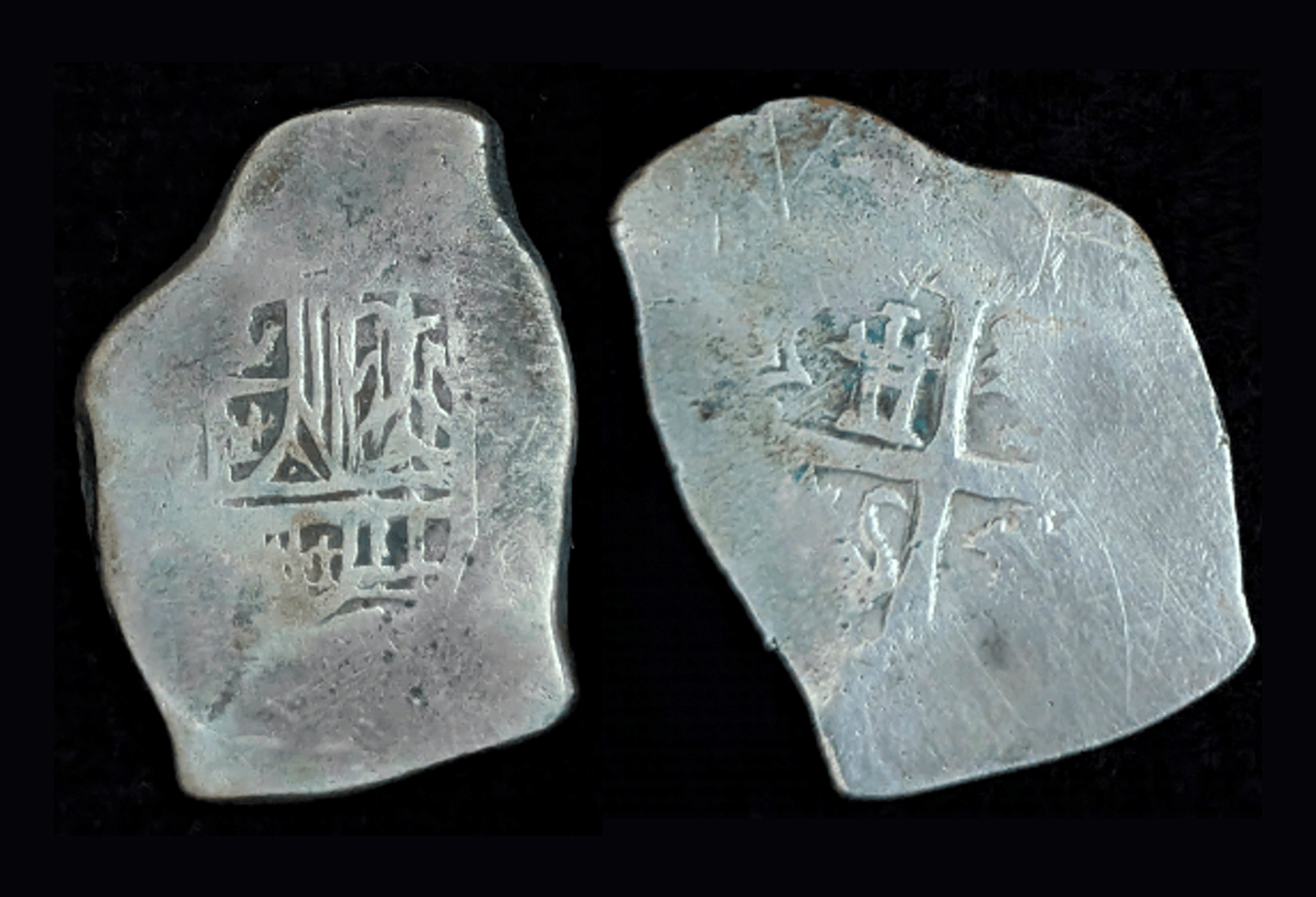
This specimen looks more like a coin produced in a mint. Looking closely at the overall shield type design, it does look similar to an early 1700s Habsburg shield; however, the entire monogram is reversed. The castle & lion quadrant is just visible in the top right corner of the shield. Visible are two lines for Aragon to the left, with the Brabant Lion below clearly on the left side, although standing almost vertical. The symbols for Flanders and Tyrol are unrecognizable. Above the shield, the crown is made of thin lines with wide troughs and even points. This is a simple design that is lost on either side of the uneven surface. On the Reverse, a cross visible only just by its points and surrounded by tressures looks like that of an ordinary early 1700s Mexico, but a sharp eye can see that the castles are reversed, revealing that this monogram is flipped as well. At the bottom of the coin, the legends look like gibberish that could be mirroring the beginning of DEI but clearly is nonsense. This could hint at an illiterate forger. This coin at first glance could easily pass as a genuine cob, and in fact it was overlooked initially. Its weight is the nail in the coffin. At only 21.49 grams, we originally thought it was a clipped coin. But after a further inspection, we believe it to be another contemporary counterfeit. All these clues lead me to believe this is another cast coin, with more of the time period die strike. Could this be an employee of the mint? Had pieces to copy? XRF data indicated 94.99% Silver, 4.70% copper, 0.20% Gold, 0.10% Lead, which is at or above mint standards.
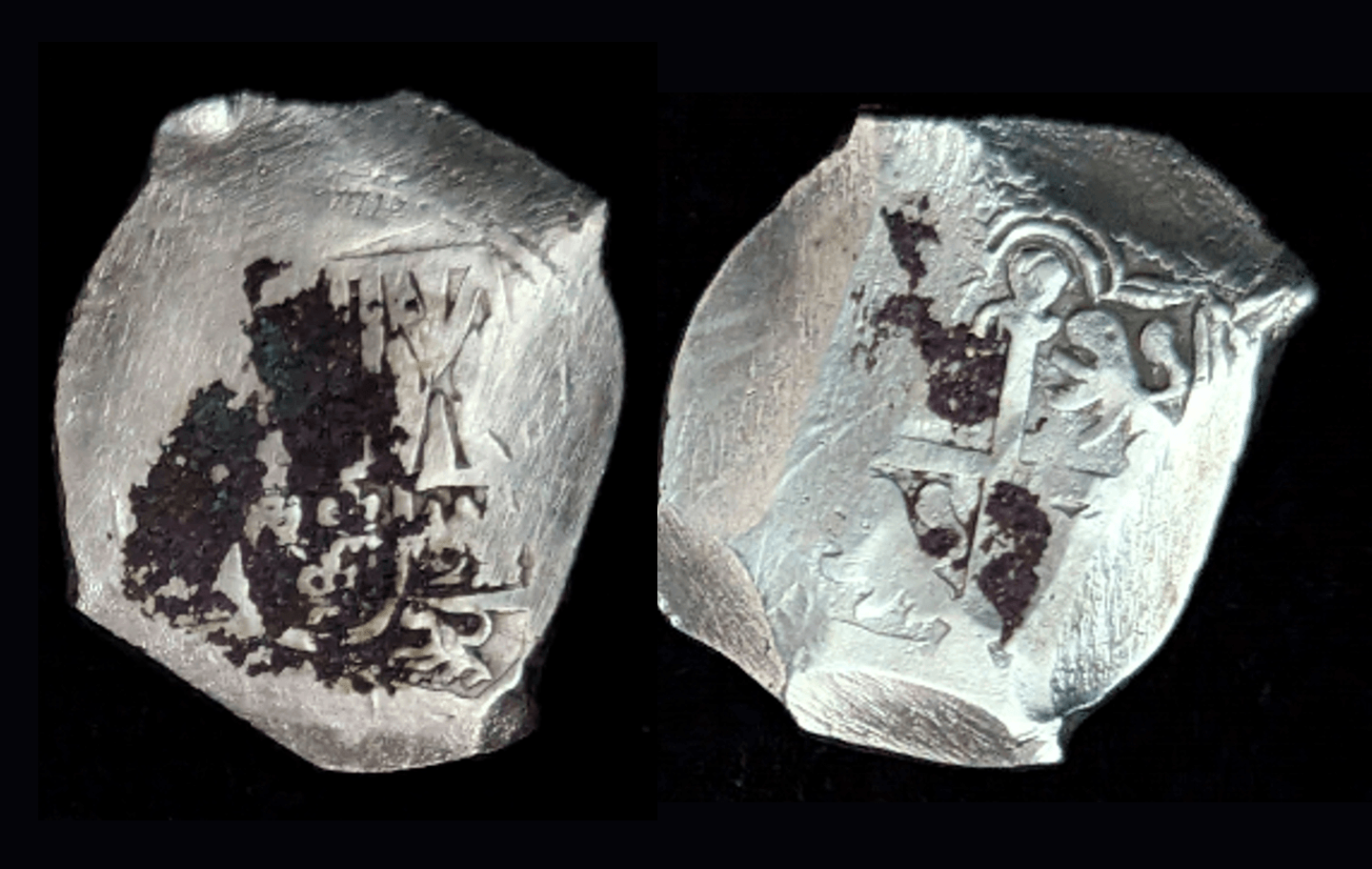
Coin 9040-50 is another fairly good forgery. The silver looks bright and white like (9019-1), but on the obverse shield side of the coin, a mild crustacean still clings to the surface, hiding some details, but the ones that we can make out are very pronounced and thick. That chunkiness blurs the details of Naples and Sicily, as well as the New Burgundy, which looks to be three fleurs-de-lis. Below, the Brabant Lion is an unusual shape with long forearms. In the center, the French Bourbons are a fairly good representation. Above the shield, just visible on the right side, is a portion of the crown. It lacks any real detail at all, with very sharp vertical points and no troughs between them, looking more like the teeth of a comb or an eyelash. On the reverse (cross side) two lions and the center of the cross look fairly well for a forgery and could pass any mint standard, considering the die strike could easily distort the lions as such. They appear identical in shape and non-typical for the type design of the time. The overall shape and surface of the coin is correct for the time period down to the file marks. Even the sharp point has been dulled with a hammer, just like coins from the mint. To prevent tearing or catching. It is the most well-done counterfeit out of the four. At 19.64 grams, it could easily pass as a simply clipped coin. But the details proved otherwise. It is hard to say if this coin was made with a die or cast like the others. There are a few “scratches” that appear to be embossed within the shield design, not in the filed surfaces, but I can’t say for sure that this means casting. This could be part of a homemade die. Subtle cupping to the reverse “cross” side supports this. Though it could be further evidence of a very good forger. XRF data: 94.78% Silver, 4.49% Copper, 0.50% Gold, 0.14% Zinc, 0.08% Lead, which is at or above mint standards.
This find essentially opened a doorway into the past, enabling us to sample a true collection of circulated fours and eights from the early 18th century. It revealed a fascinating look into the nature of forgery & manipulation of early colonial cobs. It also told a story that relates to a more personal collection of wealth. Delving into our timeline and the events that led to its scattering on the seafloor. What more could we learn from this most interesting discovery and these peculiar fakes? I hope this article encourages others to take a second look at their own collections. I am certain other examples exist. For us, digging for more is what we do best…the quest never ends!
Special thanks to: Ben Costello for data research and publication, Matthew Puleo and Sal Guttuso for data and research, Mike Perna for conservation, data, and research, and Treasure Coast Pawn for the XRF data analysis.
Reference:
Burgess, Robert F., and Carl J. Clausen. 1982. Florida’s Golden Galleons: The Search for the 1715 Spanish Treasure Fleet. Port Salerno, Florida: Florida Classics Library, p. 139.